The neon lights of Shanghai’s Jing’an District always felt like they were vibrating, but today, Leo felt he was vibrating even faster. A month ago, Leo, an American expat teaching English, couldn't even climb the stairs to his third-floor apartment without huffing. Then, he found it: 'The Vitality Forge.' It wasn't your average gym. Tucked away behind a dumpling shop, it promised more than just muscles—it promised 'Total System Optimization.' Now, after his fifth session, Leo stood on the sidewalk, the evening rain cooling his skin, but his heart racing with a strange, electric warmth. He turned to the shopkeeper next door and beamed.
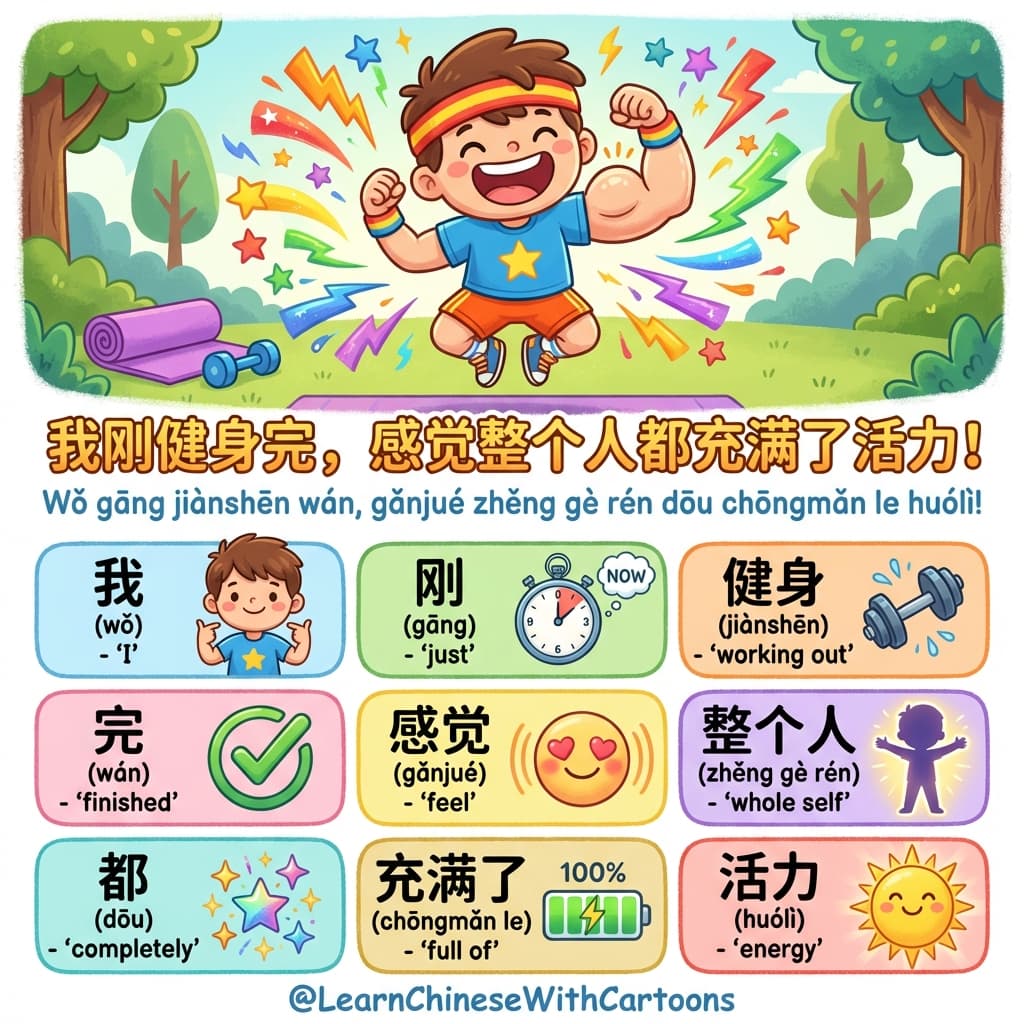
“我刚健身完,感觉整个人都充满了活力!” (Wǒ gāng jiànshēn wán, gǎnjué zhěng gè rén dōu chōngmǎn le huólì!)
This translates to: 'I just finished working out, and I feel like my whole self is full of energy!' In this lesson, we are going to dive deep into this expression of peak physical state and explore a story where energy might be more than just a feeling.
Word-by-Word Breakdown:
1. 我 (Wǒ) - I / Me
2. 刚 (gāng) - Just / Recently
3. 健身 (jiànshēn) - To work out / Fitness
4. 完 (wán) - Finished / Completed (Resultative complement)
5. 感觉 (gǎnjué) - To feel / Feeling
6. 整个 (zhěng gè) - Whole / Entire
7. 人 (rén) - Person / Self
8. 都 (dōu) - All / Completely
9. 充满 (chōngmǎn) - To be full of / Brimming with
10. 了 (le) - (Grammar particle indicating a change of state)
11. 活力 (huólì) - Vitality / Energy / Vigor
Leo’s friend, Sarah, was waiting for him at a nearby tea house. When he walked in, he didn't sit; he hovered, bouncing on the balls of his feet. 'Leo, you’re literally sweating through your shirt, but you look like you could run to Suzhou,' she remarked, eyeing him suspiciously. Leo laughed, the sound louder than he intended. 'I’m telling you, Sarah, that gym is magic. 我刚健身完,感觉整个人都充满了活力!(Wǒ gāng jiànshēn wán, gǎnjué zhěng gè rén dōu chōngmǎn le huólì!) I don’t think I’ll ever need to sleep again.'
But as the night wore on, the 'vitality' didn't fade. It intensified. His vision became sharper—he could see the dust motes dancing in the dim light of the tea house. He could hear the conversation of a couple three tables away as if they were whispering in his ear. When he went to pay, his hand shook with excess power. The cashier stared at him. Leo smiled awkwardly and repeated his mantra as if to explain away his twitching muscles: '我刚健身完,感觉整个人都充满了活力!' (Wǒ gāng jiànshēn wán, gǎnjué zhěng gè rén dōu chōngmǎn le huólì!)
Three days later, Leo hadn't slept. He had cleaned his entire apartment, rewritten his lesson plans for the next six months, and ran three marathons around the Inner Ring Road. He went back to the Vitality Forge, desperate for answers. The trainer, a man with eyes that seemed to glow like the gym’s LED strips, met him at the door. 'How do we feel today, Leo?' the trainer asked. Leo, trying to mask his growing panic with a facade of health, stammered, '我刚健身完,感觉整个人都充满了活力!(Wǒ gāng jiànshēn wán, gǎnjué zhěng gè rén dōu chōngmǎn le huólì!) But... maybe too much?'
The trainer’s smile didn't reach his eyes. 'There is no such thing as too much energy, Leo. There is only the capacity to hold it.' Leo noticed a back door slightly ajar. Beyond it, he saw rows of pods where people weren't lifting weights, but were hooked up to glowing blue cables. They weren't exercising; they were being 'charged.' A guard stepped forward, blocking his view. Leo quickly stepped back, heart hammering like a drum. 'Sorry, just looking for the locker room. 我刚健身完,感觉整个人都充满了活力!' (Wǒ gāng jiànshēn wán, gǎnjué zhěng gè rén dōu chōngmǎn le huólì!) he said, his voice cracking. He turned and bolted.
Grammar Deep Dive: The 'Gāng... Wán' Structure
In our main phrase, we use '刚...完' (gāng... wán). This is a very common way to express that you have 'just finished' an action.
- '刚' (gāng) means 'just now.'
- '完' (wán) is a resultative complement that follows the verb to show completion.
Examples:
- 我刚吃完。 (Wǒ gāng chī wán.) - I just finished eating.
- 我刚做完作业。 (Wǒ gāng zuò wán zuòyè.) - I just finished doing my homework.
The second part of the phrase uses '充满了' (chōngmǎn le). '充满' is used for abstract things like energy (活力), love (爱), or hope (希望). When you add '了', it emphasizes the current state of being full.
Cultural Corner: The 'Fitness Fever' in Modern China
Over the last decade, China has seen a massive surge in fitness culture. In cities like Shanghai and Beijing, 'gym-going' (健身 - jiànshēn) has become a status symbol and a primary social outlet for 'white-collar' (白领 - báilǐng) workers. From high-end boutique gyms to '24-hour' self-service containers, the focus on health and 'vitality' (活力) is at an all-time high. It’s common to see people sharing their 'gym selfies' on WeChat Moments with captions about their progress. However, as our story suggests, the pressure to always be 'energetic' and 'productive' can sometimes feel a bit... supernatural.
1. 健身房 (jiànshēnfáng) - Gym
2. 出汗 (chūhàn) - To sweat
3. 肌肉 (jīròu) - Muscle
4. 酸痛 (suāntòng) - Sore / Aching
5. 运动鞋 (yùndòngxié) - Sneakers / Sports shoes
6. 蛋白质 (dànbáizhì) - Protein
7. 坚持 (jiānchí) - To persist / To keep at it
8. 兴奋 (xīngfèn) - Excited
9. 疲倦 (píjuàn) - Fatigued / Tired
10. 恢复 (huīfù) - To recover / To restore
Dialogue Practice: After the Gym
(Sarah and Leo are at a juice bar)
Sarah: 嘿,里奥!你今天看起来精神真好。(Hei, Lǐ’ào! Nǐ jīntiān kànqǐlái jīngshén zhēn hǎo.) [Hey Leo! You look in great spirits today.]
Leo: 是的!我刚健身完,感觉整个人都充满了活力!(Shì de! Wǒ gāng jiànshēn wán, gǎnjué zhěng gè rén dōu chōngmǎn le huólì!) [Yes! I just finished working out, and I feel like my whole self is full of energy!]
Sarah: 你练了多久?(Nǐ liànle duōjiǔ?) [How long did you train?]
Leo: 两个小时。我出了一身汗。(Liǎng gè xiǎoshí. Wǒ chūle yī shēn hàn.) [Two hours. I worked up a real sweat.]
Sarah: 你的肌肉不酸痛吗?(Nǐ de jīròu bù suāntòng ma?) [Aren't your muscles sore?]
Leo: 一点也不。我反而觉得更兴奋了。(Yīdiǎn yě bù. Wǒ fǎn’ér juéde gèng xīngfèn le.) [Not at all. On the contrary, I feel more excited.]
Sarah: 别太累了,要注意休息。(Bié tài lèi le, yào zhùyì xiūxi.) [Don't be too tired; you need to mind your rest.]
Leo: 没问题,我会去喝一杯蛋白质奶昔。(Méi wèntí, wǒ huì qù hē yī bēi dànbáizhì nǎixī.) [No problem, I'm going to drink a protein shake.]
Leo eventually stopped going to the Vitality Forge. He realized that natural energy—the kind that comes from a good night’s sleep and a normal jog in the park—was much safer than the blue-light buzz of the secret gym. He spent weeks detoxing, his body slowly returning to its human limits. One morning, after a simple 20-minute run in the local park among the elderly people practicing Tai Chi, he sat on a bench. He felt a natural, quiet warmth. He smiled to a passing neighbor. '我刚健身完,感觉整个人都充满了活力!' (Wǒ gāng jiànshēn wán, gǎnjué zhěng gè rén dōu chōngmǎn le huólì!) This time, it was the truth. No glowing eyes, no electric heart—just the simple joy of movement.
Lesson Summary & Quiz
Today we learned how to describe the post-workout 'high' using the phrase: 我刚健身完,感觉整个人都充满了活力!
We also looked at the 'Gāng... Wán' structure and vocabulary related to the gym.
Quiz:
1. What does '活力' (huólì) mean?
2. How do you say 'I just finished eating' in Chinese using the 'Gāng... Wán' structure?
3. Which word means 'to sweat'?
4. True or False: '感觉' (gǎnjué) can mean both 'to feel' and 'a feeling.'
(Answers: 1. Vitality/Energy, 2. 我刚吃完, 3. 出汗, 4. True)