The rain in Shanghai’s old Jing’an district didn’t just fall; it reclaimed the streets. It was a heavy, grey curtain that forced the world to slow down. Leo, a young American photographer who had moved to China six months ago to capture the soul of the city, ducked under a tattered red awning. His camera bag was tucked tightly under his arm, shielded from the downpour.
As he wiped the fog from his glasses, he noticed a narrow wooden door slightly ajar. Above it hung a simple sign: 'Ink and Silence.' Curiosity, or perhaps just the need for dry ground, pushed him inside.
The air smelled of sandalwood and old paper. In the corner, an elderly man sat at a low table, his white hair tied back in a neat knot. He was grinding an ink stick into a stone slab with slow, rhythmic circles. On the walls hung scrolls of calligraphy so powerful they seemed to vibrate. There were no awards on the walls, no photos of him with famous people—just the art.
Leo watched him for a long time. The man didn't look up, yet he didn't seem to mind the visitor. Leo thought to himself: 'He looks like a simple shopkeeper, but his work is extraordinary.' Later, when Leo spoke to the local tea merchant next door, he learned the truth. The man was Master Chen, a legend whose work was sought by museums in Paris and New York. Yet, looking at him now, Leo realized: 他是一个非常谦虚的人,从不炫耀自己的成就。(Tā shì yí gè fēicháng qiānxū de rén, cóngbù xuànyào zìjǐ de chéngjiù.) [He is a very humble person who never shows off his achievements.]
The Key Phrase: Understanding the Essence of Humility
Before we continue our story, let's break down this powerful sentence. In Chinese culture, humility isn't just a polite gesture; it’s a deeply respected virtue often associated with the 'Junzi' (gentleman/noble person).
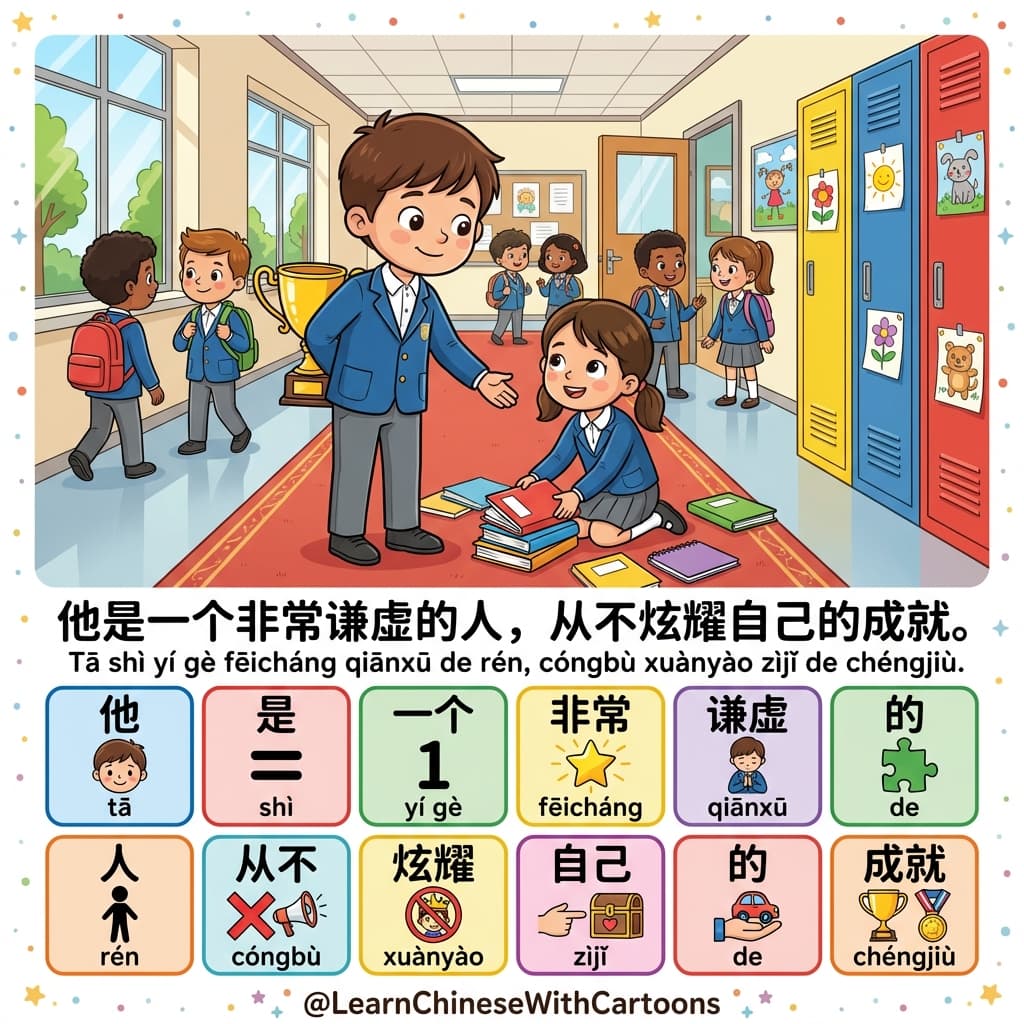
Phrase: 他是一个非常谦虚的人,从不炫耀自己的成就。
(Tā shì yí gè fēicháng qiānxū de rén, cóngbù xuànyào zìjǐ de chéngjiù.)
Meaning: He is a very humble person who never shows off his achievements.
Word-by-Word Breakdown:
1. 他 (Tā) - He
2. 是 (shì) - is
3. 一个 (yí gè) - a / one
4. 非常 (fēicháng) - very / extremely
5. 谦虚 (qiānxū) - humble / modest
6. 的 (de) - (adjective marker)
7. 人 (rén) - person
8. 从不 (cóngbù) - never
9. 炫耀 (xuànyào) - to show off / to flaunt
10. 自己 (zìjǐ) - one's own / self
11. 的 (de) - (possessive marker)
12. 成就 (chéngjiù) - achievements / accomplishments
The Story Continues: The Hidden Master
Over the next few weeks, Leo returned to 'Ink and Silence' every afternoon. He brought Master Chen small gifts—fine oolong tea or handmade paper. The old man began to teach Leo the basics of calligraphy.
One day, a wealthy businessman in a tailored suit burst into the shop. He offered a staggering sum of money for the scroll hanging behind the counter. Master Chen simply shook his head and continued grinding his ink.
'But I can make you famous!' the businessman shouted. 'Everyone should know who you are!'
Master Chen smiled softly and replied, 'The ink knows who I am. That is enough.'
Watching this, Leo felt a deep sense of respect. He told his classmate, Sarah, that night at dinner: 'You wouldn't believe it. He turned down a fortune. 他是一个非常谦虚的人,从不炫耀自己的成就。(Tā shì yí gè fēicháng qiānxū de rén, cóngbù xuànyào zìjǐ de chéngjiù.)'
Sarah leaned in, intrigued. 'In this city, everyone is trying to be someone. It’s rare to find someone like that.'
'Exactly,' Leo said. 'Whenever I try to compliment his skill, he just says he is still learning. 他是一个非常谦虚的人,从不炫耀自己的成就。(Tā shì yí gè fēicháng qiānxū de rén, cóngbù xuànyào zìjǐ de chéngjiù.) I think that's why his art is so pure.'
As the weeks turned into months, Leo’s own photography began to change. He stopped looking for the most 'Instagrammable' shots and started looking for the quiet moments. He realized that the loudest people in the room are rarely the most talented. He wrote in his journal: 'In the heart of Shanghai, I met a master. 他是一个非常谦虚的人,从不炫耀自己的成就。(Tā shì yí gè fēicháng qiānxū de rén, cóngbù xuànyào zìjǐ de chéngjiù.) Learning from him has taught me more than any photography school ever could.'
One afternoon, a group of art students from the local university came by. They had recognized Master Chen from a textbook. They were whispering and pointing, but the Master remained focused on his brush. Leo noticed how he treated the students with the same kindness as he treated the stray cat that sat by the door.
One student asked Leo, 'Is he really the Great Chen?'
Leo nodded and said in his best Mandarin, '是的。虽然他很有名,但他是一个非常谦虚的人,从不炫耀自己的成就。(Shì de. Suīrán tā hěn yǒumíng, dàn tā shì yí gè fēicháng qiānxū de rén, cóngbù xuànyào zìjǐ de chéngjiù.)' [Yes. Although he is very famous, he is a very humble person who never shows off his achievements.]
The student looked at the Master with new eyes, seeing not a celebrity, but a soul dedicated to its craft. Leo realized that true greatness doesn't need a megaphone. It is a quiet light that draws people in. He felt lucky to have found that light in a rainy alleyway. Even as Leo prepared to return home to New York, he knew he would carry this lesson with him. He would tell everyone about the man in Shanghai, always starting with: '他是一个非常谦虚的人,从不炫耀自己的成就。(Tā shì yí gè fēicháng qiānxū de rén, cóngbù xuànyào zìjǐ de chéngjiù.)'
Grammar Deep Dive: '从不' and '非常'
Let's look at two key grammatical structures used in our main phrase:
1. The Adverb '从不' (cóngbù):
This is a strong way to say 'never.' It implies a habit or a consistent state of being.
Structure: Subject + 从不 + Verb + Object.
Example: 我从不喝咖啡。(Wǒ cóngbù hē kāfēi.) [I never drink coffee.]
In our phrase, '从不炫耀' means 'never shows off.'
2. The Adverb '非常' (fēicháng):
While '很' (hěn) is the standard word for 'very,' '非常' is more intense. It literally means 'not ordinary.'
Structure: 非常 + Adjective.
Example: 这个菜非常漂亮。(Zhège cài fēicháng piàoliang.) [This dish is extremely beautiful.]
3. The use of '的' (de):
Notice we have two 'de' markers.
- 谦虚的人 (qiānxū de rén): The 'de' connects the adjective (humble) to the noun (person).
- 自己的成就 (zìjǐ de chéngjiù): The 'de' indicates possession (one's own achievements).
Cultural Corner: Humility in China
In many Western cultures, 'selling yourself' is seen as a necessary skill for success. However, in Chinese culture, the concept of 'qiānxū' (谦虚) is deeply rooted in Confucianism. To be humble is to acknowledge that there is always more to learn and that one's success is often tied to others or to luck and hard work, not just personal brilliance.
A common Chinese idiom is '满招损,谦受益' (Mǎn zhāo sǔn, qiān shòu yì), which means 'Pride leads to loss, while humility brings benefit.' When someone compliments a Chinese person, you will often hear them say '哪里哪里' (Nǎlǐ nǎlǐ) instead of 'Thank you,' as a way of playfully deflecting the praise and remaining humble.
Related Vocabulary
1. 艺术家 (yìshùjiā) - Artist
2. 书法 (shūfǎ) - Calligraphy
3. 骄傲 (jiāo'ào) - Proud / Arrogant
4. 低调 (dīdiào) - Low-key / Unassuming
5. 名声 (míngshēng) - Reputation / Fame
6. 佩服 (pèifú) - To admire
7. 秘密 (mìmì) - Secret
8. 财富 (cáifù) - Wealth
9. 传统 (chuántǒng) - Tradition
10. 境界 (jìngjiè) - Level / Realm (of mastery)
Dialogue Practice: Discussing the Master
Here is a conversation between Leo and his local friend, Li Wei, as they sit in a nearby dumpling shop.
Leo: 李伟,你认识那个书法家陈老师吗?
(Lǐ Wěi, nǐ rènshi nàge shūfǎjiā Chén lǎoshī ma?)
[Li Wei, do you know that calligrapher, Teacher Chen?]
Li Wei: 听说过。他在艺术界很有名。
(Tīngshuō guò. Tā zài yìshùjiè hěn yǒumíng.)
[I’ve heard of him. He is very famous in the art world.]
Leo: 但是他住在那么破的小巷子里。
(Dànshì tā zhù zài nàme pò de xiǎo xiàngzi lǐ.)
[But he lives in such a run-down little alley.]
Li Wei: 是啊,他是一个非常谦虚的人,从不炫耀自己的成就。
(Shì a, tā shì yí gè fēicháng qiānxū de rén, cóngbù xuànyào zìjǐ de chéngjiù.)
[Yeah, he is a very humble person who never shows off his achievements.]
Leo: 我今天看到有人想买他的画,但他拒绝了。
(Wǒ jīntiān kàndào yǒurén xiǎng mǎi tā de huà, dàn tā jùjué le.)
[I saw someone try to buy his painting today, but he refused.]
Li Wei: 对陈老师来说,艺术不是为了钱。
(Duì Chén lǎoshī lái shuō, yìshù búshì wèile qián.)
[To Teacher Chen, art isn't for money.]
Leo: 我真的很佩服他的境界。
(Wǒ zhēn de hěn pèifú tā de jìngjiè.)
[I really admire his level of mastery/spirit.]
Li Wei: 我们都应该向他学习。
(Wǒmen dōu yīnggāi xiàng tā xuéxí.)
[We should all learn from him.]
Story Conclusion
On Leo's last day, Master Chen gave him a small piece of paper. On it was written a single character: '静' (Jìng - Quiet/Stillness).
'Your photos are good,' the Master said, speaking for only the second time that month. 'But don't let the world hear you taking them. Let the world speak for itself.'
Leo walked out into the Shanghai sun, the heavy rain now just a memory. He looked at the simple paper and smiled. He knew that if he ever became a famous photographer, he would remember the old man in the alleyway. He would strive to be like Master Chen. Because, as he now knew by heart: 他是一个非常谦虚的人,从不炫耀自己的成就。(Tā shì yí gè fēicháng qiānxū de rén, cóngbù xuànyào zìjǐ de chéngjiù.)
Today we learned how to describe a person's character using the phrase: 他是一个非常谦虚的人,从不炫耀自己的成就。(He is a very humble person who never shows off his achievements.)
Quiz:
1. What does '谦虚' (qiānxū) mean?
a) Arrogant
b) Humble
c) Famous
2. How do you say 'to show off' in Chinese?
a) 炫耀 (xuànyào)
b) 学习 (xuéxí)
c) 认识 (rènshi)
3. What does '从不' (cóngbù) mean?
a) Often
b) Sometimes
c) Never
4. Translate '成就' (chéngjiù):
a) Secret
b) Achievement
c) Failure
5. Which word is used to emphasize 'very' in our phrase?
a) 不 (bù)
b) 是 (shì)
c) 非常 (fēicháng)
(Answers: 1: b, 2: a, 3: c, 4: b, 5: c)