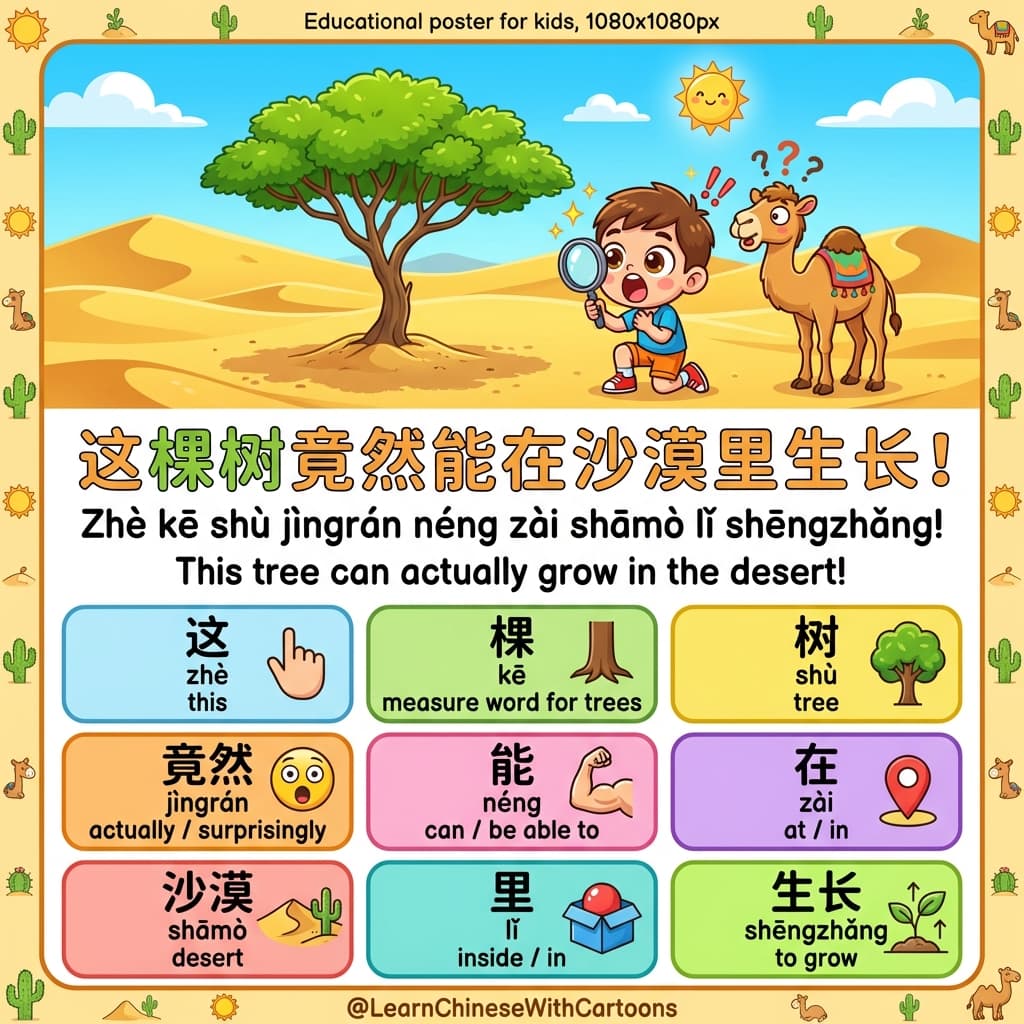
The sun was a punishing gold coin hammered into a sky of bleached white. Leo wiped the sweat from his brow, his fingers leaving streaks of dust across his forehead. He had been walking for three days through the shifting dunes of the Taklamakan, the 'Desert of Death.' His canteen was a hollow drum, and his compass spun aimlessly, caught in some localized magnetic interference. Just as he was about to surrender to the heat, he saw it—a splash of impossible green against the searing orange sand. He blinked, certain it was a mirage, but the image remained. It was a gnarled, ancient poplar, its leaves shivering in the hot wind. Leo gasped, his voice raspy and thin: '这棵树竟然能在沙漠里生长!' (Zhè kē shù jìngrán néng zài shāmò lǐ shēngzhǎng!) [This tree can actually grow in the desert!]
The Magic Behind the Sentence
Before we follow Leo deeper into the mystery of the emerald ghost, let’s break down our key phrase so you can use it to express your own amazement in Chinese.
1. 这 (zhè) - 'This'
2. 棵 (kē) - The measure word for trees (essential for noun-classifier structures!)
3. 树 (shù) - 'Tree'
4. 竟然 (jìngrán) - 'Actually' or 'Unexpectedly' (used to emphasize surprise)
5. 能 (néng) - 'Can' or 'To be able to'
6. 在 (zài) - 'In' or 'At' (preposition of place)
7. 沙漠 (shāmò) - 'Desert'
8. 里 (lǐ) - 'Inside' or 'Within'
9. 生长 (shēngzhǎng) - 'To grow' or 'Growth'
The Story Continues: The Guardian of the Sands
Leo stumbled toward the tree, his scientific curiosity momentarily overriding his thirst. He pulled out his digital tablet to record the coordinates, though he knew they were likely wrong. He spoke into the voice recorder, his tone breathless: '记录第104天。我找到了它。这棵树竟然能在沙漠里生长!' (Jìlù dì yī bǎi líng sì tiān. Wǒ zhǎodàole tā. Zhè kē shù jìngrán néng zài shāmò lǐ shēngzhǎng!) [Record day 104. I found it. This tree can actually grow in the desert!]
As he reached out to touch the rough, corky bark, a voice like grinding stones startled him. 'It does more than grow, traveler. It remembers.' An old woman sat in the shadow of the trunk, her robes the color of the dunes. Leo recoiled, then stared at her. 'How long have you been here?' he asked. She ignored him, pointing up at the canopy. 'Look closely. 这棵树竟然能在沙漠里生长!' (Zhè kē shù jìngrán néng zài shāmò lǐ shēngzhǎng!) she repeated, her eyes twinkling with a strange light. 'People think life is fragile, but this tree is made of iron and stubbornness.'
Leo scribbled notes frantically. Back at the university, his professors had laughed at the legends of the 'Ever-Living Poplar.' They said the soil here was toxic, the water table too deep. He whispered to himself as if to verify his own sanity: '这棵树竟然能在沙漠里生长!' (Zhè kē shù jìngrán néng zài shāmò lǐ shēngzhǎng!) This wasn't just a plant; it was a biological impossibility.
The woman offered him a cup of cool water from a hidden spring at the tree's roots. 'It survives because it doesn't fight the desert,' she explained. 'It invites the desert in.' Leo looked at his radio, trying to send a signal to his base camp. 'Can you hear me? I found the site! 这棵树竟然能在沙漠里生长!' (Zhè kē shù jìngrán néng zài shāmò lǐ shēngzhǎng!) Static hissed back at him, but he didn't care.
In a moment of quiet reflection, looking at the vibrant green against the dead landscape, he realized the old woman was gone. Only a small seedling remained where she had sat. He touched the small leaf and thought, '这棵树竟然能在沙漠里生长!' (Zhè kē shù jìngrán néng zài shāmò lǐ shēngzhǎng!) If it could do that, perhaps there was hope for the rest of the dying world after all. He carefully packed the seedling into his kit, knowing that the world would never believe his report: 这棵树竟然能在沙漠里生长! (Zhè kē shù jìngrán néng zài shāmò lǐ shēngzhǎng!)
Grammar Deep Dive: The Power of '竟然' (Jìngrán)
In Chinese, when you want to express that something is 'beyond expectation,' you use 竟然 (jìngrán). It sits right before the verb or adjective.
Structure: Subject + 竟然 + Verb/Adjective
Example:
他竟然不认识我!(Tā jìngrán bù rènshì wǒ!) [He actually doesn't recognize me!]
这里竟然有水!(Zhèlǐ jìngrán yǒu shuǐ!) [There is actually water here!]
Wait, what’s the difference between 竟然 (jìngrán) and 居然 (jūrán)?
Both mean 'unexpectedly,' but '竟然' is slightly more formal and often used in written narratives or serious discussions. '居然' is very common in spoken Chinese. When Leo is being a scientist, '竟然' fits his professional amazement perfectly!
Cultural Corner: China's Great Green Wall
Leo’s journey isn't entirely fiction. In northern China, the 'Three-North Shelter Forest Program' (also known as the Great Green Wall) is a massive project aimed at stopping the expansion of the Gobi Desert. Millions of trees have been planted to create a windbreak. Just like the tree in our story, these plants represent the 'stubbornness' of life and human ingenuity in the face of environmental crisis. The 'Euphrates Poplar' (胡杨 - Húyáng) mentioned in myths is famous for 'living for a thousand years, standing for a thousand years after death, and not decaying for a thousand years after falling.'
Related Vocabulary List
1. 沙漠 (shāmò) - Desert
2. 树木 (shùmù) - Trees
3. 顽强 (wánqiáng) - Tenacious / Indomitable
4. 奇迹 (qíjì) - Miracle
5. 绿洲 (lǜzhōu) - Oasis
6. 水源 (shuǐyuán) - Water source
7. 环境 (huánjìng) - Environment
8. 气候 (qìhòu) - Climate
9. 保护 (bǎohù) - To protect
10. 生命力 (shēngmìnglì) - Vitality / Life force
Dialogue Practice: At the Edge of the Oasis
里奥 (Lǐào): 你看!那是什么?(Nǐ kàn! Nà shì shénme?) [Look! What is that?]
守望者 (Shǒuwàngzhě): 那是一棵树。(Nà shì yī kē shù.) [That is a tree.]
里奥 (Lǐào): 这棵树竟然能在沙漠里生长!(Zhè kē shù jìngrán néng zài shāmò lǐ shēngzhǎng!) [This tree can actually grow in the desert!]
守望者 (Shǒuwàngzhě): 是的,它已经在这里很久了。(Shì de, tā yǐjīng zài zhèlǐ hěn jiǔ le.) [Yes, it has been here for a long time.]
里奥 (Lǐào): 它不需要很多水吗?(Tā bù xūyào hěn duō shuǐ ma?) [Doesn't it need a lot of water?]
守望者 (Shǒuwàngzhě): 它的根很深,能找到地下的水源。(Tā de gēn hěn shēn, néng zhǎodào dìxià de shuǐyuán.) [Its roots are very deep; they can find underground water sources.]
里奥 (Lǐào): 太神奇了,这是一个奇迹。(Tài shénqí le, zhè shì yī gè qíjì.) [Too amazing, this is a miracle.]
守望者 (Shǒuwàngzhě): 生命总是很顽强的。(Shēngmìng zǒngshì hěn wánqiáng de.) [Life is always very tenacious.]
Lesson Summary & Quiz
Today we learned how to use '竟然' to express shock and '棵' as a measure word for trees. We also explored the resilient vocabulary of the desert.
Quiz:
1. What is the measure word for trees? (Answer: 棵 kē)
2. How do you say 'Desert' in Chinese? (Answer: 沙漠 shāmò)
3. Where does '竟然' go in a sentence? (Answer: Before the verb/adjective)
4. Translate: 'Life is a miracle.' (Answer: 生命是一个奇迹 Shēngmìng shì yī gè qíjì)