The raindrops danced on the ancient grey tiles of Lijiang, rhythmic like a heartbeat Leo had forgotten how to listen to. He sat by the window of the 'Cloud & Tea' house, his laptop screen glowing with a half-finished sentence that had been staring back at him for three hours. Being a travel writer sounds romantic until you find yourself stuck in a town so beautiful it intimidates your prose into silence.
Across the room, Mei was wiping down the mahogany counter. She wasn't just the owner of the shop; she was a force of nature. Every morning at 5:30 AM, Leo would hear the rhythmic 'thud-thud-thud' of her sneakers against the cobblestones outside his guesthouse. While he was drowning in caffeine and writer's block, she was conquering the Jade Dragon Snow Mountain foothills.
She looked up, caught his eye, and walked over. She didn't offer more tea. Instead, she leaned against the table and asked a question that would change the course of his stay:
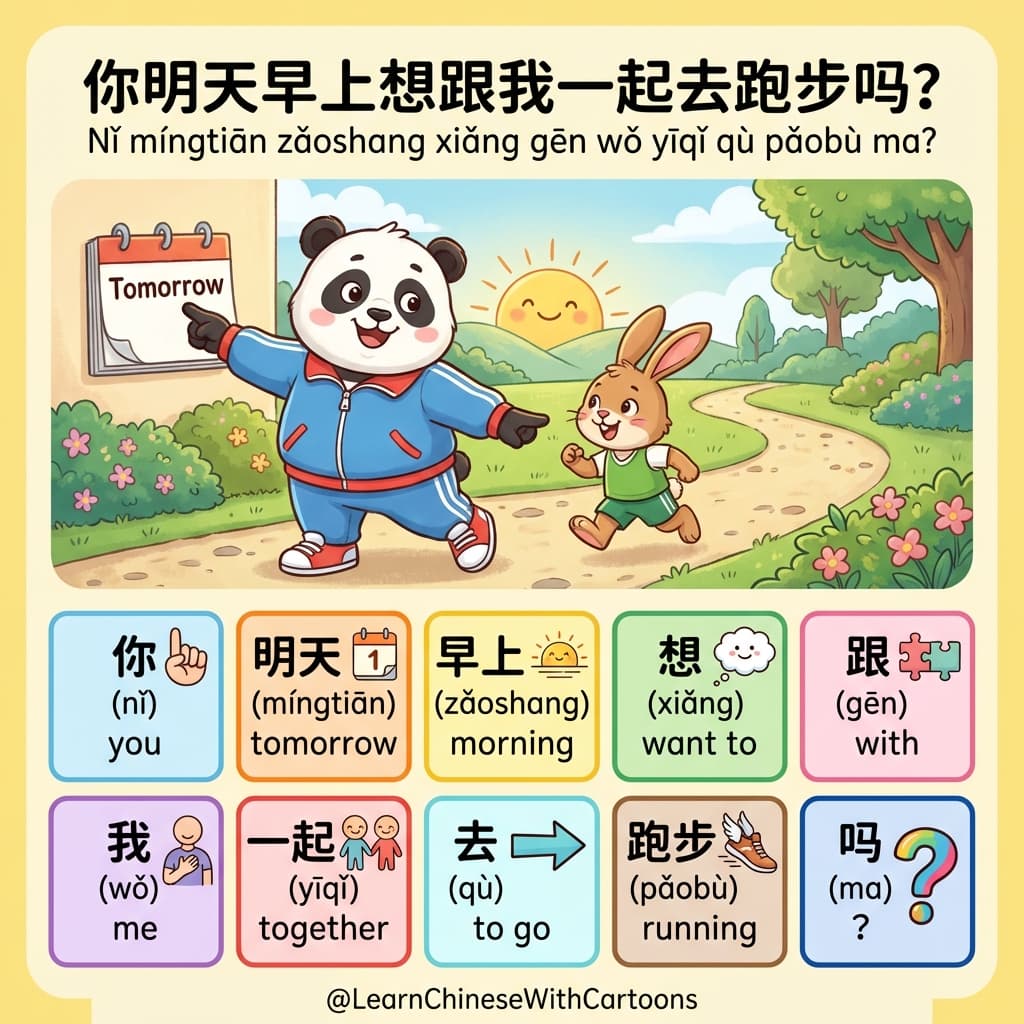
“你明天早上想跟我一起去跑步吗?” (Nǐ míngtiān zǎoshang xiǎng gēn wǒ yīqǐ qù pǎobù ma?)
Leo blinked. He understood the words, but the concept of 'running' and 'morning' in the same sentence felt like a foreign language entirely.
The Key Phrase: Breaking it Down
Before we continue our story, let's look at this invitation piece by piece. This is a versatile sentence structure you can use for almost any social invitation.
你 (Nǐ) — You
明天 (míngtiān) — Tomorrow
早上 (zǎoshang) — Morning
想 (xiǎng) — Want to / Would like to
跟 (gēn) — With
我 (wǒ) — Me
一起 (yīqǐ) — Together
去 (qù) — To go
跑步 (pǎobù) — Running / To run
吗 (ma) — [Question particle]
Total Meaning: Would you like to go running together with me tomorrow morning?
The Resistance and the Rehearsal
Leo stammered. 'I... I don't have the right shoes.' Mei laughed, a bright sound that cut through the humidity of the rainy afternoon. 'Excuses don't burn calories, Leo. Think about it.'
That night, Leo couldn't sleep. The phrase haunted him. He stood in front of the mirror in his small room, trying to get the tones right. He wanted to say it back to her, to show he wasn't just another lazy tourist.
“你明天早上想跟我一起去跑步吗?” (Nǐ míngtiān zǎoshang xiǎng gēn wǒ yīqǐ qù pǎobù ma?) he whispered to his reflection. His 'míngtiān' was too flat. His 'pǎobù' sounded like he was falling down stairs.
Determined to get it right, he walked downstairs to the guesthouse courtyard. There, he found Mr. Wang, the elderly night watchman, sipping lukewarm tea.
'Mr. Wang,' Leo asked in hesitant Chinese. 'Can you check my pronunciation?' He took a deep breath and said, “你明天早上想跟我一起去跑步吗?”
Mr. Wang chuckled, his face wrinkling like a dried plum. 'Your 'zǎoshang' is a bit weak, but the spirit is there. But why are you asking me? I am seventy-eight years old!'
'I'm practicing for Mei,' Leo admitted, blushing.
'Ah,' Wang nodded wisely. 'Then you better keep practicing. She doesn't wait for anyone.'
The Silent Invitation
The next morning, Leo didn't go. He stayed in bed, listening to the 'thud-thud-thud' pass by his window at 5:45 AM. He felt a pang of guilt. When he went to the tea house at noon, there was a small note tucked under his usual teapot.
It was written in elegant, swift calligraphy:
“你明天早上想跟我一起去跑步吗?” (Nǐ míngtiān zǎoshang xiǎng gēn wǒ yīqǐ qù pǎobù ma?)
There was no signature, but a small hand-drawn mountain at the bottom gave it away. She wasn't giving up.
Leo realized that in China, fitness isn't just a solo pursuit; it’s a community event. He looked out the window and saw the local 'dancing grannies' in the square, moving in perfect synchronization. He realized he was missing out on the soul of the city by sleeping through its most vibrant hours.
That evening, he finally caught Mei as she was closing up.
'Mei!' he called out. She turned, her eyebrows arched in challenge.
He didn't stumble this time. He looked her in the eye and used her own phrase: “你明天早上想跟我一起去跑步吗?”
Mei smiled, a real smile this time. 'I thought you’d never ask. 5:30 AM. Don't be late.'
Grammar Deep Dive: The 'With' Structure
In Chinese, when you want to do something 'with' someone, the structure is different from English.
Structure: Subject + 跟 (gēn) + Person + 一起 (yīqǐ) + Verb.
In our main phrase: 你 (Subject) + 跟 (with) + 我 (Person) + 一起 (together) + 去跑步 (Action).
Note: You cannot put 'with me' at the end of the sentence like in English. 'I go running with you' becomes 'I with you together go running' (我跟你一起去跑步 Wǒ gēn nǐ yīqǐ qù pǎobù).
Also, '想' (xiǎng) indicates a desire or a polite suggestion, whereas '要' (yào) can feel a bit more forceful or urgent. When inviting someone, '想' is usually the warmer choice.
Cultural Corner: The 'Morning Air' (晨练)
In China, the early morning (早上 zǎoshang) is considered the most auspicious time for health. You will see parks filled with people practicing Tai Chi, swinging their arms (shuaishou), or even walking backward—a practice believed to help with back pain and balance. This is known as 'chénliàn' (morning exercise).
By inviting Leo to run, Mei wasn't just asking for a workout partner; she was inviting him to participate in a vital part of Chinese social life. In the West, we often run with headphones on, isolated. In China, exercise is an invitation to connect with your environment and your neighbors.
Related Vocabulary
1. 锻炼 (duànliàn) — To exercise / To work out
2. 公园 (gōngyuán) — Park